
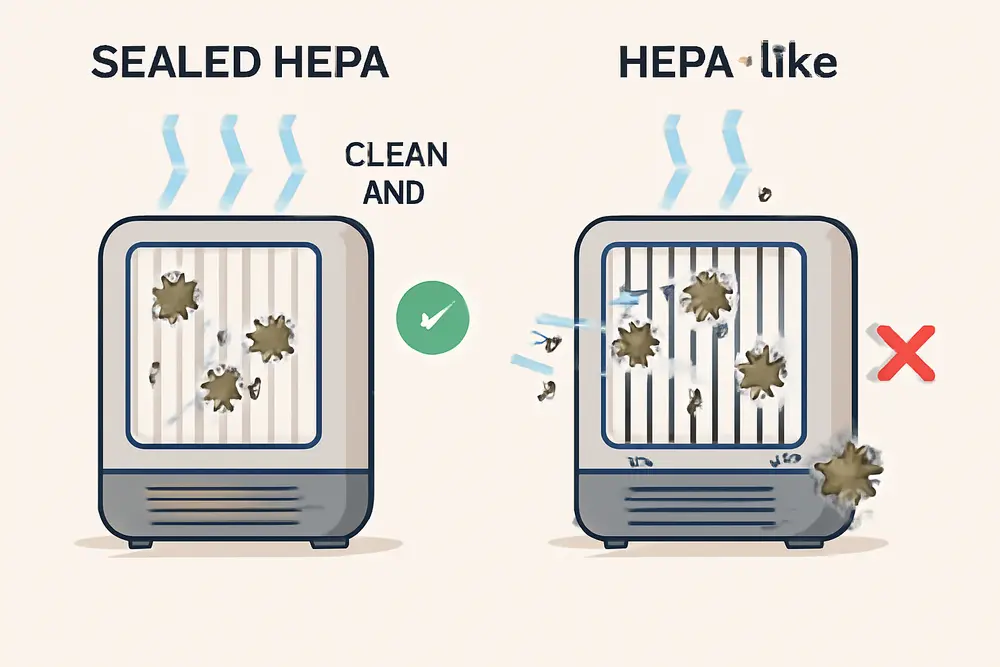
If you point a shop vac at a mold patch, you might as well point a confetti cannon at your lungs. Mold cleanup is a containment game, and the vacuum is either your ally or your saboteur. The difference comes down to this: a sealed HEPA vacuum traps what you suck up. A shop vac, even with a HEPA filter, often leaks spores right back into your home. In this guide I’ll show you why sealed, true-HEPA systems beat HEPA-like marketing fluff, how to spot the red flags on labels, and simple setup moves that keep spores from hopping a ride to the next room.
Why HEPA Matters For Mold Cleanup
Mold spores are tiny, stubborn, and born to travel. Many common spores sit in the 2 to 10 micron range, and fragments from disturbed colonies can be even smaller. When you vacuum moldy dust, you aerosolize loose spores. If your machine leaks anywhere between the intake and the exhaust, you just turned a small colony into a house tour for spores.
That is why professional standards like IICRC S520 and EPA guidance specify HEPA vacuuming during remediation, and not the casual kind. A true HEPA setup captures at least 99.97 percent of particles at 0.3 microns, the most penetrating particle size, but that only matters if the air path is sealed so it can’t bypass the filter. Mold remediation also leans on containment, negative pressure, and careful order of operations so you’re lowering the spore load before you remove materials and again after you clean. We stress that in our own remediation workflow because it prevents cross-contamination to clean rooms and your HVAC. If you want the long version of that process, my team lays it out on our Mold Clean Up Services page, including when we install containment and how we finish with whole-home cleaning to keep spores from riding the airflow highway into your ducts. You can read that here: Mold Clean Up Services.
Sealed HEPA vs Shop Vac
Let’s translate the marketing talk into what actually keeps your air safe during cleanup.
What True HEPA Really Means
True HEPA is a performance standard, not a vibe. It means the filter captures 99.97 percent of particles at 0.3 microns. For mold work, that filter must live inside a sealed system. That means gaskets where the filter sits, sealed housings, tight bag compartments, and no loose seams at latches or hose ports. If air can sneak around the filter, it will. Mold Removal Lab and multiple remediation guides call this out plainly: without a sealed design, spores bypass the filter and get launched into the room you’re trying to fix. Reference: Mold Removal Lab on HEPA vacuums. Renovett’s remediation advice says the same thing and recommends professional-grade machines with completely sealed systems because consumer vacuums often skip the sealing part: Renovett on HEPA vacuuming.
Why Shop Vacs Fail Mold 101
Plenty of shop vacs offer optional HEPA filters. The problem is the rest of the machine. Those plastic tubs, latches, and lids are usually not engineered to be airtight in the way remediation demands. Air takes the path of least resistance, which is through those gaps. IICRC S520 and EPA guidance for school and commercial building remediation both point to using HEPA vacuums that are part of a sealed system, not a vacuum that just accepts a HEPA-style cartridge. When you add a HEPA filter to a leaky shop vac, you built a very loud spore sprinkler.
Could a shop vac be used to suck up bulk water or big debris before remediation? Sure. But for mold vacuuming, especially after you disturb colonies, you want a sealed HEPA vacuum. That is the difference between removing contamination and recirculating it.
Spotting HEPA-Like Labeling
Here is where the packaging tries to fool you. Terms like HEPA-like, HEPA-type, HEPA-style, or even fancy phrases like medical grade sometimes get slapped on filters that do not meet true HEPA performance or certification. Air quality pros draw a bright line: True HEPA meets the 99.97 percent at 0.3 micron threshold and has independent certification, while HEPA-like can be anything from decent to useless. Sources like AirPurifiers.com and IndoorHumidity.com note that HEPA-like filters often sit in the 85 to 95 percent range at 0.3 microns and skip formal certification entirely. That missing 5 to 15 percent at the most penetrating particle size is exactly where mold fragments slip through. References: True HEPA vs HEPA-type, IndoorHumidity on HEPA performance.
What to look for on the label and spec sheet:
If it does not literally say 99.97 percent at 0.3 microns, it is not true HEPA. If it cannot point to a standard like DOE HEPA or EN 1822 or to third-party test results, keep walking. If the marketing leans on HEPA-like labeling or cute percentages at a different particle size, you are not getting mold-ready filtration. And if the product glosses over sealing details, gaskets, or a sealed filter chamber, assume it is not designed for remediation containment.
| Feature | Sealed True HEPA Vacuum | HEPA-Like Vacuum | Shop Vac With HEPA Filter |
|---|---|---|---|
| Filtration Claim | 99.97% at 0.3 micron, certified | Vague or lower efficiency claims | Depends on add-on filter |
| System Sealing | Sealed intake to exhaust, gasketed | Usually unsealed or partial | Typically unsealed canister and lid |
| Use For Mold Work | Yes, meets remediation best practice | No, risk of bypass leakage | No, can re-aerosolize spores |
| Bag/Filter Handling | Designed for sealed removal | Varies, often messy | Often open bucket disposal |
| Typical Cost | Higher, professional-grade | Mid to low, consumer-grade | Low to mid, general-purpose |
Setup Tips That Contain Spores
You can own the perfect sealed HEPA vacuum and still lose the containment game if your setup is sloppy. Here is a field-tested approach I wish every DIYer would copy.
Start by fixing the moisture source so you are not cleaning a problem that will just return. Shut down or isolate the HVAC that serves the affected area so you do not pull spores into your ductwork. If you need a primer on why HVAC is a spore superhighway, this article is a quick read: Mold in HVAC Systems: Risks and Prevention Tips.
Set up light containment. For small jobs in the under 10 square foot range on nonporous surfaces, close doors, cover supply and return vents, and hang plastic over doorways using painter’s tape and a zipper if you have one. If you own or can rent a HEPA air scrubber, run it in the room and exhaust outside or use it to create slight negative pressure to keep air moving into the work area, not out. Skip household fans because they tend to blast spores around and defeat containment.
Wear PPE that actually seals. That is at least an N95 respirator, better yet an elastomeric half-face with P100 cartridges if you’ll be in there for a while. Add gloves, goggles without vents, and disposable coveralls if you’re disturbing growth or cutting material.
Vacuum technique is slower than you want it to be. Start with a pre-pass to reduce loose spore load before you touch the colony with a scraper or a blade. Use a brush tool only if it’s HEPA-safe and clean, and keep agitation minimal so you do not turn patches into clouds. Work top to bottom, moving the nozzle slowly enough that you hear the pitch change as it lifts dust rather than skating over it. After demo or cleaning, vacuum again to capture what you stirred up. Then spot clean surfaces with detergent and water on nonporous materials and discard porous items that stayed wet or grew mold. Bleach on porous drywall is like perfume on a skunk. It does not fix the problem inside the paper. Finish with a final HEPA vacuum pass once the area dries.
Disposal matters. Power down the vacuum, let it sit a minute so dust settles in the bag, then remove the bag or filter gently and seal it immediately in a plastic bag. Double-bag if you had heavy growth. EPA’s mold remediation guidance points to sealed disposal of filters and contaminated debris, and that is good practice for homes too. You can reference their guidance here: EPA Mold Remediation Guide.
Decontaminate tools. Wipe down hoses, wands, and hard attachments with a detergent solution or an EPA-registered disinfectant appropriate for mold cleanup. Do not forget your footwear. Step out of the room, peel PPE carefully, and wash up so you do not track spores into the living room.
Real-World Scenarios And What I’d Do
Bathroom ceiling with a small mold patch from a steamy shower: Fix the ventilation fan first. Hang plastic to cover the doorway and vent grilles. Use a sealed HEPA vacuum to pre-vac, then clean the nonporous paint with detergent and water, let dry, and repaint with a mold-resistant coating if needed. Skip the shop vac and skip bleach. If the paint is bubbling and the paper face of drywall is affected, cut back the damaged section and replace it.
Flooded basement with visible mold on exposed studs after a week of humidity: Dehumidify aggressively, set up containment at the stairwell, and leave the HVAC serving the rest of the house off or isolated. Pre-vac studs and surfaces with the sealed HEPA vacuum, then remove porous insulation and any baseboards or drywall that stayed wet. Clean remaining framing with detergent, let dry, and consider a second HEPA vacuum pass. A shop vac here will spread it to the first floor faster than you can say decon. This is the kind of job where a HEPA air scrubber and professional support are worth it if you’re not experienced.
Attic mold on the north side of the roof deck from poor ventilation: Improve ventilation first. Because attics are connected to living spaces through recessed lights and chases, insist on a sealed HEPA vacuum and good containment at the access hatch. Many attics are better left to pros because insulation removal, negative pressure setup, and safe working platforms matter just as much as the vacuum.
Dusty return plenum with suspect mold in duct insulation: Stop. Do not vacuum ducts with a consumer machine. Our team uses controlled vacuums and brush systems designed so debris is captured, not blown into other sections of the house. If your HVAC is involved, bring in pros who can isolate and clean it using HEPA filtration and the right tooling. We explain why HVAC needs special handling here: Mold in HVAC Systems.
DIY Or Call The Pros?
If the total affected area is under 10 square feet, confined to nonporous surfaces, and you have a sealed HEPA vacuum plus basic containment gear, you can usually handle it with patience and care. If the area is larger, involves porous building materials, keeps coming back, smells musty despite cleaning, or touches the HVAC, get a professional assessment. Also get help if anyone in the home is immunocompromised or highly sensitive to allergens. Our quick read on warning signs that justify a professional cleanup is here: 7 Warning Signs You Need Professional Mold Cleanup.
Quick Specs That Actually Matter
If you’re shopping for a vacuum you can trust for mold work, focus on these details instead of shiny marketing stickers:
Look for true HEPA performance listed as 99.97 percent at 0.3 micron, not just HEPA-like labeling. Choose a model that advertises a sealed system with gasketed filter chambers and sealed bag compartments. Bagged designs with self-sealing bags keep disposal clean. A crushproof hose with tight connections helps, and a smooth interior hose reduces places for dust to accumulate. Variable suction control is a plus so you can avoid launching debris when you first touch a surface. Skip bagless cyclonic machines for mold remediation. The canister dump is a contamination party, and most lack sealed exhaust paths. Finally, read the manual for filter change intervals and sealing steps. If the instructions do not mention sealed bag removal, the manufacturer was not thinking about bioaerosols during design.
Common Label Red Flags
HEPA-type or HEPA-like without test data. Percent capture listed at a particle size other than 0.3 microns without a 0.3 micron spec. Medical grade claims without certification details. Big airflow numbers without any mention of sealing features. All of those scream marketing, not remediation.
Frequently Asked Questions
Can I drop a HEPA filter into my shop vac and be safe?
No. The filter might be good, but the canister, lid, and hose ports on most shop vacs are not airtight. Spores bypass the filter and exit the exhaust. For mold work you need a sealed HEPA vacuum built to keep every bit of air on the filtered path.
What size of mold patch is reasonable for DIY?
Under 10 square feet on nonporous surfaces with no HVAC involvement is usually manageable if you use a sealed HEPA vacuum, simple containment, and proper PPE. Anything larger, recurring, inside porous materials, or touching the HVAC is a call-the-pros situation.
Do I need a HEPA air scrubber for small jobs?
It helps, but it is not always required for tiny areas. A sealed HEPA vacuum, localized containment, and shutting down nearby HVAC can be enough. For bigger areas, a HEPA air scrubber set for negative pressure is the standard play.
Should I fog instead of vacuuming?
No. Fogging or spraying biocides without physical removal leaves dead growth and debris in place and can push moisture where you do not want it. The remediation sequence is source control, containment, HEPA vacuuming, removal or cleaning, then any targeted antimicrobial step, then final HEPA vacuuming. Our general process overview is here: Mold Clean Up Services.
Can I reuse a HEPA filter after mold cleanup?
Follow the manufacturer’s instructions. Many sealed HEPA vacuums use disposable HEPA filters and bags that should be changed after mold work, especially if you handled visible growth. If your unit has a reusable prefilter, clean it per instructions outdoors and bag any debris.
What about H13 or H14 ratings?
Those European EN 1822 classes are often used in air purifiers. The key is still the 0.3 micron capture rate and a sealed system. H13 aligns with the 99.97 percent at 0.3 micron idea. Without a sealed machine, the filter class is trivia.
The Case For Sealed HEPA In One Sentence
A sealed HEPA vacuum removes moldy dust and keeps it in the machine, while a shop vac or HEPA-like vacuum lets spores slip around the filter and escape. That single design detail is the difference between actually cleaning and just relocating the problem. If you want help choosing equipment or you’re staring at a bigger mess than you planned, our team is happy to step in with containment, sealed HEPA vacuums, and the rest of the remediation playbook.