
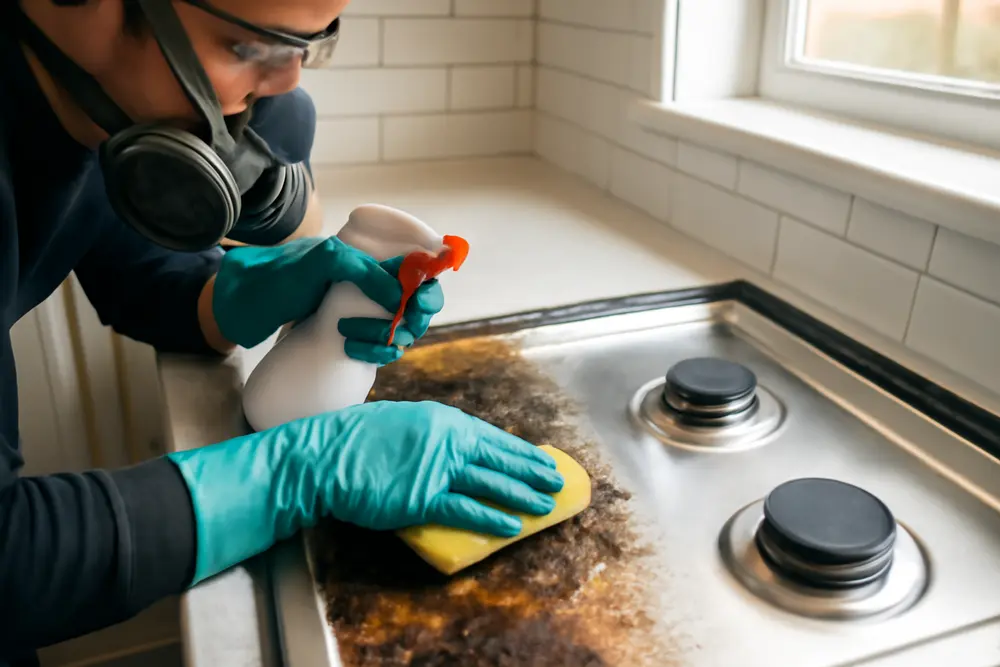
If your kitchen now smells like scorched chicken soup with a side of gym bag, but you barely see any soot, congratulations, you’ve met protein fire residue. It’s the invisible sticky soot from low-flame cooking mishaps that clings to everything, bulldozes your nose, and laughs at your store-bought degreaser. It spreads quietly through your home, often hitching a ride in your HVAC, and it will keep reappearing until you break it down the right way. As a restoration pro who cleans up after more kitchen flare-ups than I care to admit, here’s the straight talk on what it is, how far it spreads, and the exact protein fire restoration process that actually works.
What Is Protein Fire Residue?
Protein fire residue is the nearly invisible film left when protein-rich foods like meat, poultry, or dairy burn at relatively low heat. Instead of the big, fluffy soot you see after high-flame fires, protein fires leave a thin, clear to light-yellow film that hugs surfaces tight and puts out a sour, rancid odor that stings your nose. Think less chimney soot, more sticky fingerprint you can’t quite wash off. The science checks out: when proteins partially combust, they can polymerize and bond stubbornly to surfaces. That bond is why ordinary cleaners usually smear it and make the odor worse instead of better. Sources like RestorTech and Haddad’s describe this residue as almost invisible yet brutally odorous.
Even small incidents cause it. A pot simmering dry, bacon forgotten under a low flame, or a roast that “rested” for three hours because someone napped on the couch can fog a kitchen without obvious smoke. Your eyes say it’s fine. Your nose says it isn’t. Believe your nose.
Signs You Have Invisible Sticky Soot
First, the odor. People describe it as burnt meat, sour grease, or weirdly chemical. It loves to linger and seems to get stronger when the HVAC cycles or when humidity changes. Second, a tacky feel. Run a clean white cloth on cabinets or a painted wall near the kitchen and you might get a faint yellow-brown transfer, or just feel a draggy, gummy smear that wasn’t there before. Ceiling surfaces, light fixtures, and cabinet faces are usual suspects. Third, sneaky discoloration. Around light switches, door frames, and high-touch areas, you may notice dulling or a slight amber tint. Finally, your HVAC filter may look clean but smell bad, and every time the air handler runs, the house gets a lovely encore of Eau de Burnt Protein.
How Far Does It Spread?
Short answer: farther than you think. Protein fire residue rides quiet air currents, floats out of the kitchen, and coats ceilings and walls room to room. Range hoods and microwave vents can turn into launchpads. Open-concept homes invite it to set up shop across the entire first floor. It settles on glass, tile, painted surfaces, finished wood, and contents like dishes and fabrics. Sources like Restoration Local note that even rooms that look fine often carry a thin film.
The HVAC system is the super-spreader. Ducts, coils, and the air handler pull in the odor compounds, then redistribute them like a polite but persistent skunk. Restoration Intel points out that untreated ducts are a common reason odors return after an otherwise decent cleaning. You clean the kitchen, flip on the AC, and bang, the house smells like burnt stew again.
Why Wiping Fails
This residue is bonded, not just dusty. Spraying a general-purpose cleaner or vinegar on a cabinet door and giving it a quick wipe will usually smear and spread the film. Worse, warm water can volatilize odor compounds and make the smell flare up while you clean. Standard alkaline cleaners may cut grease but often fail to break protein bonds locked onto paint, varnish, and porous surfaces. According to Restoration Intel, the residue’s partial combustion changes how it grips surfaces, so chemistry matters a lot more than elbow grease.
Another trap is painting. If you roll fresh paint over unneutralized residue, you’ve basically sealed stink under a thin blanket. It will ghost through, or the paint can fail to adhere well. We see it constantly: beautiful paint job, same old smell. That isn’t a paint problem. It’s a prep problem.
The Pro Cleanup Sequence
Here’s the protein fire restoration process we follow in real jobs. Skipping steps is how odors survive.
| Step | What’s Done | Why It Matters |
|---|---|---|
| 1. Identify Residue | Confirm protein fire residue vs. dry or wet soot. Use odor cues, test cleaning patches, and inspect HVAC. | Protein films need targeted chemistry, not generic soot methods. Source |
| 2. Stabilize Site | Shut off HVAC, set containment if needed, use air scrubbers with HEPA and carbon, gear up with PPE. | Prevents spread and reduces VOC exposure during cleaning. Source |
| 3. Dry Clean First | HEPA vacuum and dry-wipe to lift loose residue without smearing. | Wet cleaning too soon pushes film deeper. Source |
| 4. Enzyme Chemistry | Apply enzyme cleaner for protein residue and allow proper dwell time, then agitate. | Enzymes help break protein bonds that hold odor. Source |
| 5. Alkaline Follow-Up | Use a controlled alkaline degreaser to tackle remaining film and oils. | Breaks down fatty components and stubborn films. Source |
| 6. Rinse and Dry | Thorough rinse, wipe to neutral pH as required, then dry surfaces. | Leftover cleaner or residue can cause odor rebound or surface damage. |
| 7. HVAC Remediation | Replace filters, clean coils and ducts, and address air handler surfaces. | Stops recontamination and recurring odor. Source |
| 8. Deodorize | Hydroxyl generation, thermal fogging, or limited ozone when appropriate. Encapsulate if needed. | Reaches odor in pores, cavities, and structural voids. Source |
| 9. Seal or Repaint | Prime with odor-blocking sealers on stained or penetrated surfaces, then repaint. | Locks in residual odors and provides a clean finish. Source |
The ANSI/IICRC S700 Standard for Professional Fire and Smoke Damage Restoration sets the playbook for identifying residues and choosing methods. The 2025 update tightened guidance on odor management and verification. If a restorer can’t talk shop about S700, they’re guessing when they should be testing.
Inside the HVAC Problem
Every room tied to your HVAC becomes a potential odor relay. Protein residues and smoke odor compounds collect on filter fibers, dust inside ducts, and on evaporator coils. Start the system and you just launched a perfume cannon. During mitigation, the system stays off until cleaning and deodorization reach a point where we can safely run air circulation through high-capacity filtration. Filters get swapped early and at least once again after duct cleaning. Coils and blowers get cleaned with products compatible with their metals and coatings. Ducts get agitated and vacuumed with proper negative pressure, not just a quick brush-and-pray pass.
We often place carbon-loaded air scrubbers in strategic locations, especially near returns, to grab VOCs while surfaces are treated. If you skip HVAC remediation, the rest of your cleaning will feel like a treadmill workout. Lots of sweat, no distance covered.
Odor Neutralization Options
Surface cleaning is step one. Then comes neutralization for what you cannot see. Hydroxyl generators are popular because they run in occupied spaces and attack odor-causing molecules in air and on surfaces. Thermal fogging uses a heated mist of counteractant designed to follow the same paths smoke did. It can be a powerhouse when paired with thorough cleaning. Ozone is potent but not a toy. It’s for unoccupied spaces with strict controls and post-treatment ventilation. Use it wrong and you can degrade rubber, some textiles, and sensitive electronics. Encapsulating sealers provide a final lock when a stained surface has been cleaned to the limit of what chemistry can do.
The right choice depends on material types, occupancy needs, and the odor profile we’re facing. There isn’t a single silver bullet. That’s why the best results come from a layered plan, verified by actual odor checks and, in some cases, particulate and VOC monitoring.
When to Seal or Repaint
Seal when a surface still shows staining or holds a faint odor after proper enzyme and alkaline cycles with rinse-back to neutral. This shows up most with older alkyd paints, bare or unsealed wood inside cabinets, and drywall that had a direct hit above a stove. We spot prime stubborn areas with a smoke-rated sealer, then prime larger areas for uniformity. Paint goes on only after passes the sniff test and a moisture check when water-based cleaning was used. Painting sooner won’t speed anything up. It usually just gives you a prettier wall that still smells like burnt Sunday brunch.
Picking the Right Team
Ask direct questions. How do you confirm it’s protein fire residue and not wet soot? What enzyme cleaner for protein residue do you use and what’s the dwell time? How will you handle HVAC odor spread, including coils and ducts? What’s your odor verification process before repainting? Do you follow ANSI/IICRC S700 and document pH-neutral after cleaning on painted finishes? If the answers include hand-waving or “we just paint it,” keep shopping.
Experience with kitchen fires matters more than owning a fogger. Protein fires are a niche inside a niche. A crew that knows how to set containment, sequence dry and wet steps, and protect finishes will finish faster and with fewer callbacks. If you hear them talk about turning off the HVAC first, using HEPA and carbon scrubbers, and running enzyme chemistry before anything else touches your cabinets, you’re on the right track.
Prevention You’ll Actually Use
Use the range hood every time you cook on the stove, and run it 10 to 15 minutes after you finish. Keep lids nearby for grease flare control. Set a timer on your phone for anything simmering. If you sear or roast high-protein foods often, wipe range hoods and cabinet faces weekly with a mild degreaser to prevent buildup that will amplify odors if you ever have a mishap.
Keep the right fire extinguisher close, the kind labeled for grease and ordinary combustibles. Never throw water on a grease fire. If something burns and odors get strong, kill the HVAC and open a window before turning on a bunch of fans. You don’t want to power-spread invisible sticky soot through the house in the first 10 minutes.
Real-World Example: The Sunday Roast
We were called to a two-story home after a beef roast slow-cooked itself into a hockey puck. Minimal smoke was visible when the owner walked in. They aired the place out, wiped the counters, and thought they were good. Two days later, the whole house smelled like a sports bar at closing time. When we arrived, there was almost nothing on a quick glance. But a white microfiber pass on the painted ceiling came back with a faint tan tint and a greasy feel. The HVAC filter didn’t look terrible, yet the odor hit hard at the return grille.
We shut down the HVAC, set a carbon-loaded air scrubber at the return, and started dry cleaning with HEPA vacuums and dry sponges from the kitchen outward. Then we applied an enzyme cleaner with proper dwell across cabinets, ceilings, and adjacent rooms, followed by a controlled alkaline rinse. The rinse water looked like weak tea. After neutral pH checks and drying, we moved to HVAC cleaning, replaced filters, and ran a short hydroxyl cycle while we finished contents wipe-downs. Two cabinet interiors needed sealing. After that, odor dropped off a cliff. The owner had planned to repaint the entire first floor. We only painted the kitchen ceiling and the two cabinet interiors, because we didn’t trap any residue under fresh paint. That’s the value of sequence and chemistry.
Got Questions About Protein Fires?
Why does my house smell so bad if I barely see smoke?
Protein fire residue is nearly invisible but bonds tight to surfaces and carries strong odor compounds. Your eyes can miss it while your nose can’t ignore it. This is a classic protein profile validated by industry guides like Haddad’s.
Will cleaning with vinegar fix it?
Vinegar can help with mineral scale and light kitchen odors, but it is not designed to break protein bonds from a fire. It often smears the film and amplifies the smell during cleaning. Enzyme cleaners and controlled alkaline steps work better for protein residues, confirmed in technical writeups and trade articles.
Can I just replace the HVAC filter and be done?
No. Filters help, but coils, the blower housing, and ducts can hold residue and stink. Replacing only the filter is like changing a trash bag without emptying the can. Proper HVAC remediation is one of the biggest differences between temporary relief and a real fix, as industry sources warn.
Is ozone safe to use for odor?
Ozone can be effective when used by trained pros in unoccupied spaces with strict controls and ventilation afterward. It is not for occupied use. Wrong application can damage materials or irritate lungs. Many restoration teams prefer hydroxyl generators and thermal fogging first for occupied homes.
Do I have to repaint the whole house?
Usually not. If you sequence cleaning properly and verify pH and odor at each step, you only seal or repaint surfaces with staining or persistent odor. Skipping cleaning and jumping to paint, however, often leads to repainting twice.
How do pros verify results?
Through visual and tactile checks, pH testing after alkaline steps, odor assessments with the HVAC running, and sometimes particulate or VOC readings. The S700 framework emphasizes verification, not just spraying and praying.
Protein fire residue is a sneaky opponent. It hides in plain sight, clings harder than it should, and recruits your HVAC as an odor megaphone. Beat it with the right chemistry sequence, slow-and-steady rinsing, and real HVAC remediation. If your kitchen smells like a burnt buffet even after a scrub, stop guessing, shut the system down, and bring in a crew that treats protein residue like the specific beast it is. The sooner the right process starts, the less repainting and sealing you’ll need, and the faster your home stops smelling like last month’s overcooked leftovers.