
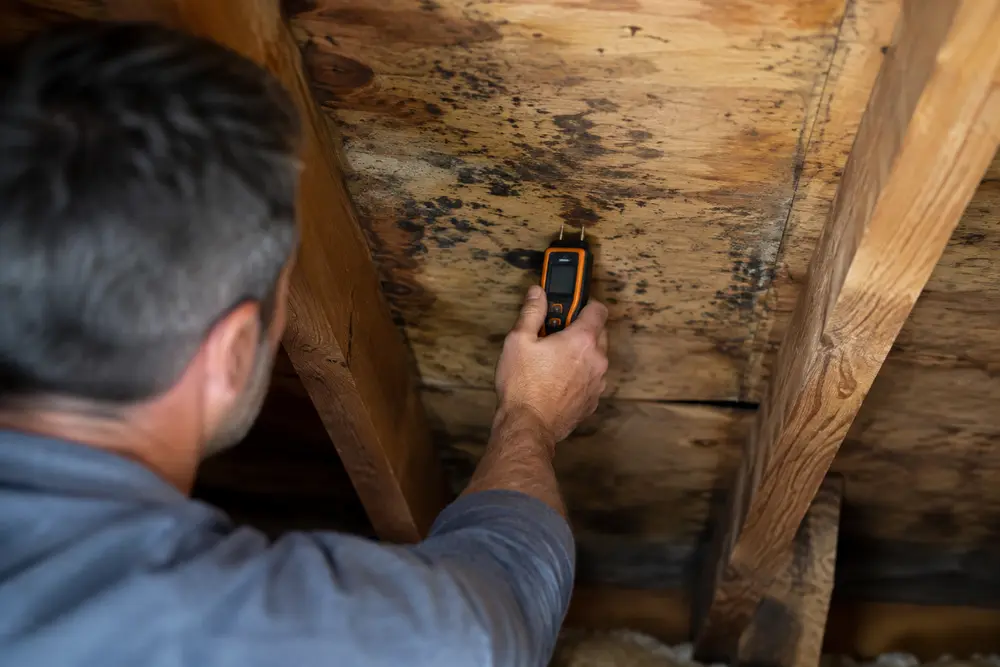
For your San Antonio home, attic mold remediation often starts in the several-thousand-dollar range and can reach five figures when you’re dealing with roof damage or widespread insulation removal. Your budget needs to cover the moisture correction as well as the mold work.
You won’t find one reliable attic mold removal price because contractors may measure different parts of your job. Mold growth on your roof decking, insulation spread across the attic floor, and repairs to your roof each use a different measurement.
The largest money trap you can fall into is approving cleanup while the moisture source remains active. Your fresh insulation and cleaned framing can become contaminated again after the next hard rain or another round of duct condensation.
A sound mold remediation estimate should separate your diagnosis from the cleaning and explain what will happen to contaminated insulation. If your quote skips those details, the attractive total may simply be incomplete.
The Measurements Behind the Quote
You shouldn’t use total attic area as a shortcut for estimating remediation. If you have a 1,500-square-foot attic, that doesn’t automatically mean you have 1,500 square feet of affected material. The actual growth might cover 250 square feet of your roof decking, while access requirements force the crew to remove 700 square feet of insulation below it.
Your estimate should identify the affected mold surface and the insulation footprint separately. Roof repairs are usually measured under their own scope. Containment or final cleaning may be based on your broader work area because dust and debris don’t stay directly below one stained rafter.
Attic Costs That Belong in the Budget
For planning, you can use the following ranges, but they aren’t a contractor quote or a universal San Antonio price sheet. Your attic access and current labor costs can move the final number considerably.
| Attic Expense | Planning Range | Main Cost Driver |
|---|---|---|
| Moisture inspection and attic assessment | $250 to $800 | Access and diagnostic work |
| Texas assessment, protocol, and sampling when applicable | $500 to $1,500+ | Project size and laboratory charges |
| Localized roof or flashing repair | $350 to $2,000+ | Leak location and damaged decking |
| Extensive roof work | Several thousand to $20,000+ | Roof area and material |
| Bath-fan or duct correction | $300 to $2,500+ | Duct routing and exterior termination |
| Containment and negative air | $750 to $2,500+ | Attic entry and occupied space below |
| Decking and framing remediation | About $4 to $12 per affected square foot | Growth density and surface condition |
| Insulation removal and disposal | About $1 to $3.50 per square foot removed | Insulation depth and attic access |
| Replacement insulation | About $1.50 to $4 per square foot | Insulation type and installed depth |
| HEPA cleaning and final detail work | $500 to $2,000+ | Debris and dust migration |
| Post-remediation verification | $300 to $1,000+ | Project scope and sampling requirements |
Your moisture diagnosis deserves its own line item because the source isn’t always your roof. A bathroom fan may discharge into the attic. Poorly insulated HVAC ducts can sweat during humid San Antonio weather, while air leaking around your attic hatch can carry household moisture upward.
When you review containment costs, keep in mind that the work involves more than hanging plastic around the attic opening. The crew may need negative-air equipment and protection for the occupied rooms below. Worker protection is part of legitimate remediation too, which is one reason you should be skeptical of a cheap spray-only proposal.
Structural repairs can add another variable when your decking or framing has deteriorated. Surface growth on sound decking may be cleanable, but soft or delaminated sheathing may require carpentry. A coating won’t restore wood that has physically deteriorated.
The Expensive Mistake: Cleaning First
You won’t get a lasting result from mold cleanup while water keeps reaching the material. The EPA’s mold and moisture guidance makes the same basic point: you have to address the moisture problem as part of the solution.
If your roof is leaking, you may need a temporary dry-in before permanent repair can be scheduled. Final cleaning should normally wait until the leak has been corrected and your affected materials can dry. Removing unsafe wet material earlier can make sense, but rebuilding your attic around an active leak doesn’t.
Consider what your budget might look like with 300 square feet of affected decking and 500 square feet of contaminated insulation. Your assessment might cost $750, followed by a $1,200 flashing repair. Add $1,500 for containment, $2,400 for wood remediation, $1,000 for insulation removal, $1,250 for new insulation, and $600 for verification. Your illustrative total would be $8,700.
If you reverse that order, the cost can rise substantially because you may pay for the same work twice. Suppose you spend about $7,500 on remediation and insulation but delay the $1,200 flashing repair. Moisture returns, creating another $5,500 of removal and cleaning work. Your combined expense reaches about $14,200 because you purchased containment and labor twice. That example isn’t a prediction, but the duplicated costs are very real.
Adding attic vents without diagnosing the moisture pathway first can waste more of your money. More ventilation can be useful for your roof’s design, but it won’t repair failed flashing or stop a leaking duct connection. In my experience, automatic vent upgrades are often oversold.
Insulation Can Reshape the Budget
Your insulation can turn a limited roof-deck problem into a larger attic project. Wet or visibly contaminated insulation may need removal because you can’t reliably clean porous material completely. The insulation may have to come out when it blocks safe access to your affected framing too.
You should expect removal and replacement to appear as separate expenses in a complete estimate. A quote that includes “insulation handling” should state whether you’re paying for bagging old material, installing new material, or both. Disposal charges and your attic access can materially change the removal cost.
Once your attic floor is exposed, you have a useful opportunity to seal air leaks before new insulation goes in. Gaps around ceiling penetrations and open wall cavities can move your conditioned air into the attic. The Building America attic air-sealing guidance explains how those leakage points affect heat and moisture movement. Paying for air sealing once is usually more sensible than burying the same gaps under your fresh insulation.
Texas Rules and Better Estimates
If your Texas mold project involves 25 contiguous square feet or more, it generally falls under state requirements unless an exemption applies. Texas regulates mold assessment and remediation, and the Texas Department of Licensing and Regulation mold program provides current licensing information and consumer guidance.
Your qualifying project may require a licensed assessment consultant to prepare the protocol and a separately licensed remediation contractor to perform the work. Post-remediation assessment and a Certificate of Mold Remediation may affect your budget as well. That separation helps you because the company defining your scope isn’t the same party being paid to complete every line item.
Before you accept an estimate, check whether it clearly includes:
- Your moisture source and the party responsible for correcting it
- The measured roof-deck area included in your remediation
- The insulation footprint scheduled for removal
- Containment and protection for your rooms below
- Hauling charges and replacement insulation
- Required Texas assessment documents
- Post-remediation verification
- Potential carpentry or roof-deck change orders
A lump-sum “attic treatment” doesn’t tell you enough about the scope. Ask what product will be applied, which materials will receive physical cleaning, and how the contractor determined your work area. You shouldn’t accept fogging or encapsulation alone as a fix for active water entry.
Your warranty language deserves the same scrutiny you give the scope and price. Some warranties depend on you repairing the roof or correcting an exhaust duct first. That condition is reasonable, but you should see it in writing before work begins.
Common Questions About Attic Mold
Is Attic Mold Removal Covered by Insurance?
Your coverage depends on your policy and the cause of the moisture. Mold following a covered sudden event may be treated differently from growth caused by an old leak or deferred maintenance. Photograph your affected area and contact your insurer before removing materials when there’s no immediate safety concern.
Does Stained Roof Decking Need Replacement?
Discoloration alone doesn’t prove that your roof decking has lost structural strength. Replacement may be appropriate when your wood is soft, delaminated, or otherwise deteriorated. Sound decking may be suitable for cleaning under your remediation protocol.
How Long Does Attic Mold Remediation Take?
You should allow several days for a limited attic mold project. Your roof scheduling and material drying can lengthen the process, while independent verification can add time after the physical work is complete. Make sure your estimate distinguishes working days from the full calendar timeline.
Is Air Testing Always Necessary for Attic Mold?
You don’t automatically need air sampling as the first step in an attic investigation. Visual findings and moisture measurements often give you more useful information about the scope. Your project protocol may require sampling, or it may be used for post-remediation verification under applicable Texas procedures.
Can You Stay Home During the Work?
Remaining in your house is often possible when the attic is properly isolated from your occupied space. Your access location and the amount of material being removed affect that decision. Ask how the crew will contain your attic opening and where the exhaust air will discharge.
For a budget based on your actual roof, insulation, and work area, call Sapphire Restoration at (210) 664-0770 or request an attic mold estimate.
References
- A Brief Guide to Mold, Moisture and Your Home (epa.gov)
- Mold Assessors and Remediators Homepage (tdlr.texas.gov)