
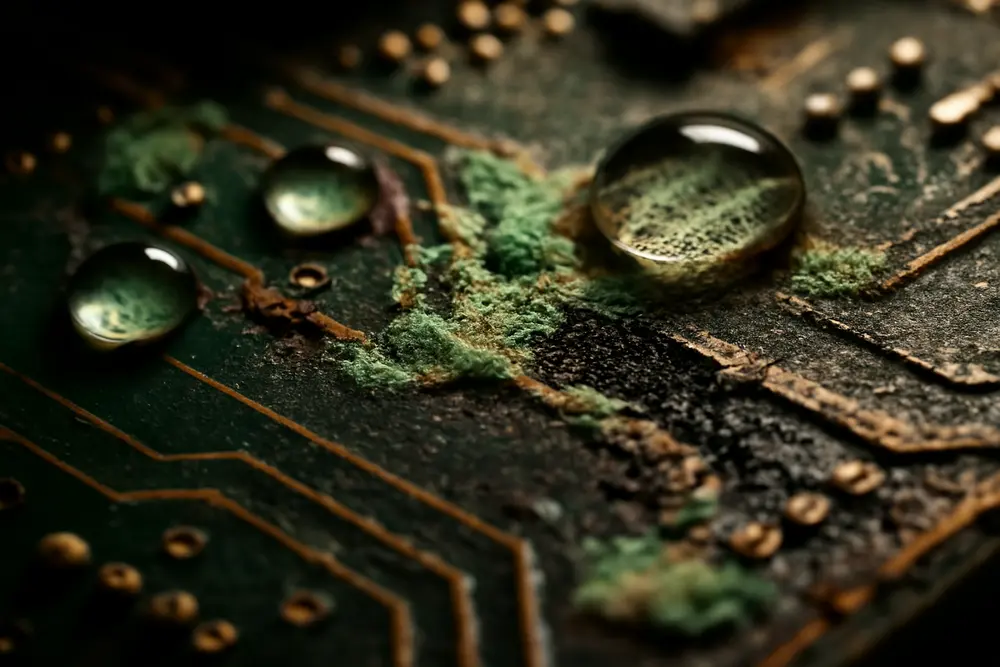
If your TV took a smoke bath, it did not suddenly decide to start vaping. That haze on your circuit boards is acidic soot, and it starts eating metal in hours. I own a restoration company and I’ve watched clean-looking laptops die quietly on day two because someone tried to power them on to see if they still worked. This is your post-fire electronics triage guide with real-world steps, a circuit board corrosion timeline, and exactly when pros can still pull your gear back from the brink.
Why Soot Eats Electronics
Smoke from burning plastics, wiring insulation, and furniture carries acidic byproducts and conductive contaminants. Those microscopic particles ride the air, settle on metal, and, when mixed with moisture from firefighting or humidity, create a thin, corrosive film. That film bridges pins and traces, invites galvanic corrosion, and starts etching copper and solder almost immediately. Translation: the clock is ticking, and powering devices only accelerates the damage by driving current through contaminated paths.
The Corrosion Timeline
Here’s the circuit board corrosion timeline I use when making save-or-replace calls. It is not scare tactics. It is chemistry on a schedule.
| Time After Fire | Inside The Device | What That Means For You |
|---|---|---|
| 0 to 1 hour | Acidic soot lands and coats connectors, traces, and solder. | Best odds to save it if power stays off and the environment is stabilized. |
| 1 to 24 hours | Early corrosion starts on exposed copper and tin. Moisture turns residue into a weak electrolyte. | Most items are still restorable with proper cleaning. Do not test power. |
| 24 to 48 hours | Etching and oxidation accelerate. Tarnish and pitting form, especially under connectors. | Restoration is still possible but costs go up. Some components may need replacement. |
| 48 to 72 hours | Corrosion creeps under chips and into tight interfaces. Plated contacts degrade. | Odds drop fast. Powering up now can cause shorts and permanent failure. |
| Beyond 72 hours | Residues harden, corrosion becomes hidden and widespread, especially with prior water exposure. | Selective restoration or data-only recovery may be the only smart play. |
What To Unplug And Avoid Powering
If it smelled smoke, assume it ingested smoke. That includes TVs, game consoles, desktops, laptops, servers, routers, smart speakers, thermostats, appliances with control boards, garage door openers, and chargers. Unplug them and keep them off. Pull removable batteries from laptops, cameras, and UPS units. If you can safely isolate power to an affected zone at the panel, do it. Do not power anything to see if it still works. That one curious button push often turns a cleanable board into a toast-worthy paperweight.
First-Hour Stabilization
Speed beats heroics. Your goal is to stop the chemical reaction and keep residue from migrating deeper.
Move affected electronics out of smoky, humid rooms and into a cleaner, drier space. Spread items so air can circulate. Keep cases closed and covers on to avoid grinding soot deeper. Unplug every external cable and accessory. For exteriors, use a soft brush and a HEPA vacuum on low with a brush attachment to lift loose soot from vents and surfaces. No canned air, no leaf blowers, no glass cleaner, and no spritzing alcohol into ports. Set out desiccant packs or silica gel around items to pull down ambient moisture. If you have a portable HEPA air scrubber, run it nearby to reduce airborne particulates that would otherwise re-deposit. If water exposure occurred, do not tilt or shake devices to sling water around. Keep them oriented as-found and let pros control the drying.
When Pros Can Still Save It
Good restorers do not spray and pray. We disassemble, document, and decontaminate with processes designed for electronics, not countertops. Expect steps like ESD-safe teardown, HEPA pre-vacuuming, and targeted soot removal. Boards may go through ultrasonic cleaning with electronics-safe chemistry, followed by deionized water rinses and controlled drying in a low-humidity oven. Solvent flushing, vapor degreasing, and contact replacement take care of stubborn residues and tarnished connectors. After that comes inspection for heat warping and reflowed solder, resistance and insulation testing, and only then a staged power-up. If you are inside that 24 to 48 hour window and the device did not take a bath, odds are solid. Past 72 hours, we can often still rescue higher-value gear, industrial controls, or recover data from drives even when the host device is a loss.
When To Call It A Loss
Some electronics are not worth the parts and labor rodeo. Charred boards, melted connectors, warped casings, and obviously reflowed or sunken components signal replacement. Smoke plus suppression water plus three days in a closed house usually knocks out lower-cost items like budget printers, power strips, and sealed gadgets that cannot be opened for proper cleaning. Appliances with sealed controls that cannot be accessed safely are frequent write-offs. When in doubt, triage by value: the $40 toaster goes, the $4,000 workstation gets a restoration bid, and the family photos on a smoke-exposed PC get a data-recovery plan regardless.
Real-World Triage Examples
Gaming PC in a bedroom two doors from the fire: side panel closed, light soot on the case, no water spray. We bag it with desiccant on day one, clean boards ultrasonically on day two, and it passes staged power on day three. Save. 65-inch TV mounted in a living room that filled with smoke: the rear vents act like lungs. Owner tried to power it up on day one and it ran for ten minutes before popping. Internal short burnt a trace. Partial save at best and the panel is often a goner. Replace. Office router closet where the sprinkler ran for 15 minutes: switches and router racks saturated, humidity off the charts. We can frequently restore enterprise gear if we get it within 24 hours, but consumer gear that sat powered and wet is usually not worth it. Mixed outcome.
What About Data?
Do not power smoke-exposed computers to grab a file. Drives and SSDs can usually be removed, cleaned, and imaged on clean benches without risking the rest of the machine. If the computer looks rough but the data matters, ask for a data-first plan. Even when the device fails, your photos and QuickBooks file often do not.
Stuff That Sounds Smart But Is Not
Rice is a snack, not a restoration method. It does little for corrosive residues. Ozone generators and aggressive deodorizing inside electronics can attack rubber, plastics, and contact plating. Household cleaners leave conductive films. Compressed air spreads soot deeper. Hair dryers push humid, warm air into tight spaces and bake in residues. If the method looks like a TikTok hack, skip it.
Insurance And Documentation
Take clear photos, record serial numbers, and make a list by room. Split into three buckets: restore, questionable, and replace. Your adjuster will ask for this, and a solid post-fire electronics triage list speeds approvals. For higher-value items, get a restoration estimate alongside a replacement quote so the decision is about math, not guesswork.
FAQ
How fast do smoke residues start corroding circuit boards?
Within hours. The first hour is already doing work on exposed metals, and the 24 to 48 hour mark is where the curve bends upward. That is why keeping power off and stabilizing humidity quickly matters.
Can I safely test devices for just a second?
No. That second can arc across soot-contaminated pins and burn traces that were still cleanable. Wait for inspection and cleaning.
Should I wipe boards with isopropyl alcohol?
Not before disassembly and not while residues are still mobile. Alcohol can move contaminants under chips and into connectors. External casings only, and even then keep liquids away from vents and ports until a pro opens the device.
What if the device never got wet?
Great, your odds go up. Moisture accelerates corrosion, so keeping things dry with desiccants and HEPA filtration buys time for proper cleaning.
When should I call a professional?
Immediately after you have unplugged and stabilized items. The earlier we get devices into controlled drying and decontamination, the better the outcome and the lower the bill. If you are searching for post-fire electronics triage or a circuit board corrosion timeline because you just had a fire, the window is already open.